
Bostany
Heritage e-commerce
What a 125-year-old Egyptian pantry brand looks like online, taken far enough to click through.
- Role
- Self-directed concept: research, design system and frontend
- Timeline
- 2026
- Type
- E-commerce concept for a heritage food brand
- Platforms
- Web
Stack
The problem
EL BOSTANY has been making food in Damietta since 1900. Roughly thirty products across eight categories and seven sub-brands sit on Egyptian shelves, and almost none of it exists online in a form a customer can browse. The brand's own catalogue is a PDF.
This one is ours rather than a commission: an argument, made in code, for what a heritage pantry brand should look like online. Working without a client brief put the harder questions first. Not whether a storefront can be built, but what a century of shelf presence becomes on a phone, and what Egyptian e-commerce needs that an imported template quietly leaves out.
Approach
Heritage without the museum
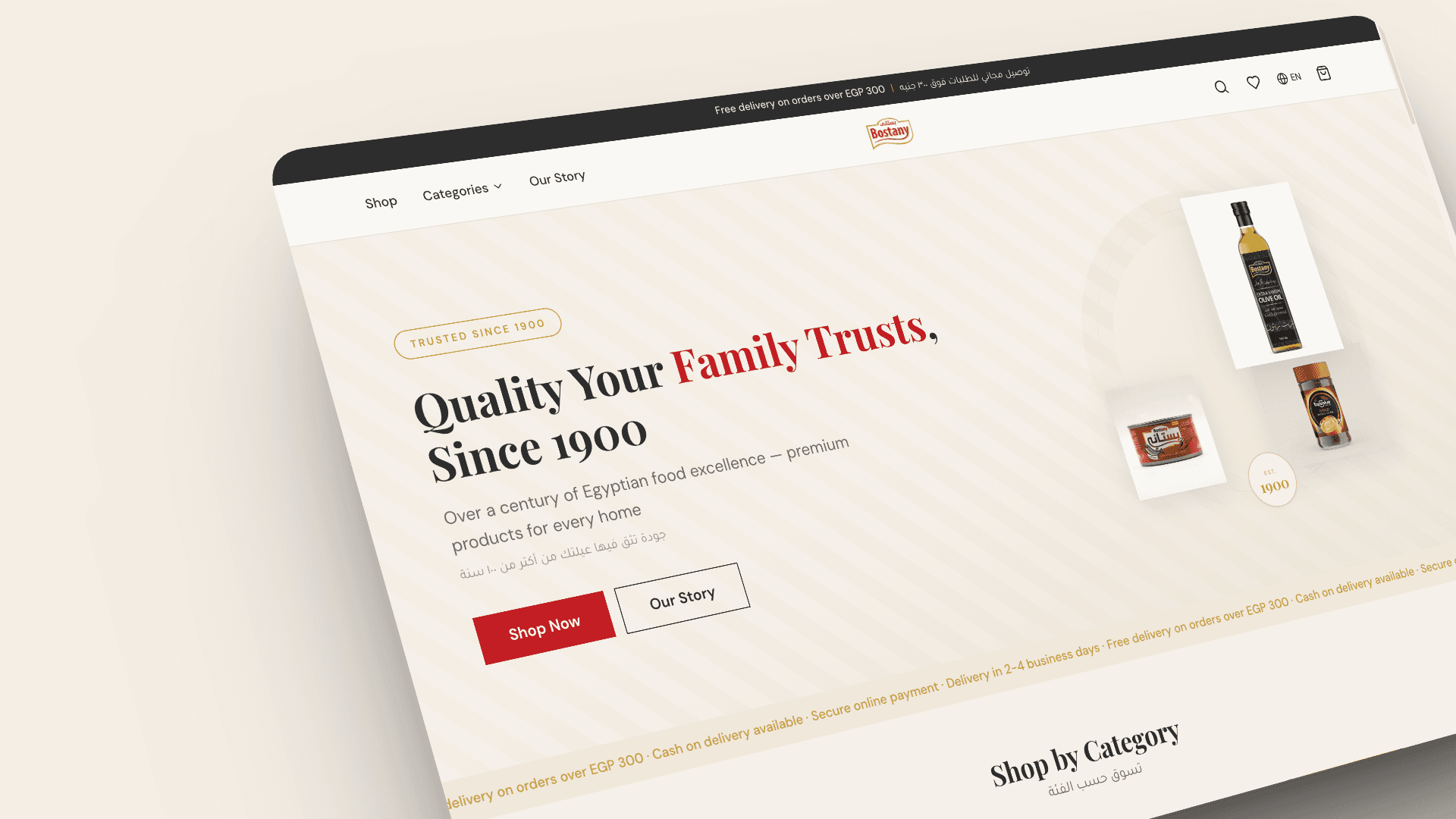
The palette comes off the packaging rather than a trend board: the Bostany red, a heritage gold, cream instead of white. Playfair Display carries headings against DM Sans for body, with Tajawal doing both jobs in Arabic, and each of the eight categories gets its own accent so olive oil and coffee do not read as the same aisle. The brief we set ourselves was a well-curated food magazine meeting clean e-commerce, which mostly meant resisting two easy defaults: the cold startup look that would make a 1900 brand feel rented, and the discount-grocer look that would undersell it.
Arabic is not a translation layer
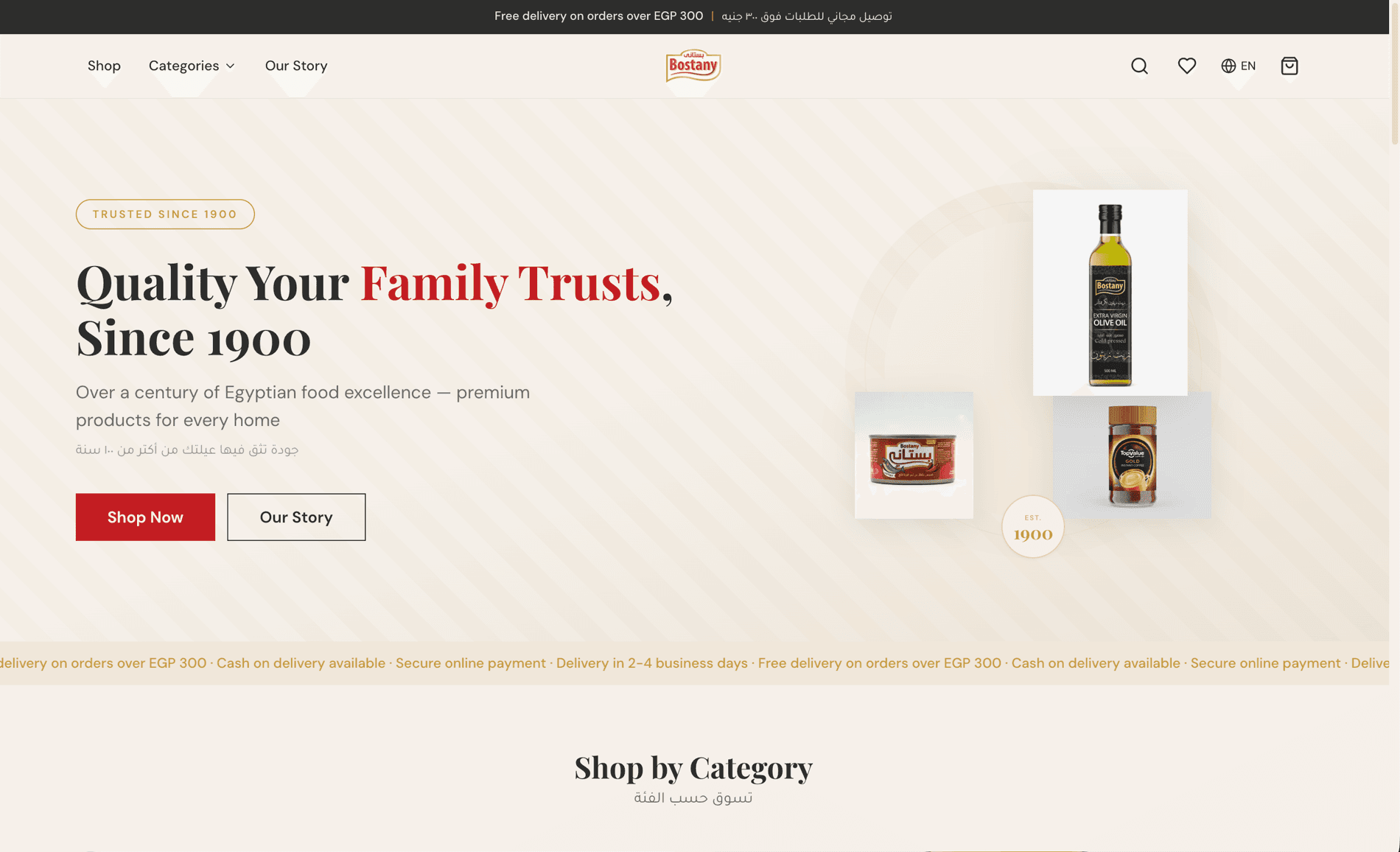
The catalogue is bilingual down to the slug. Every product carries paired English and Arabic fields for name, description and URL, so an Arabic shopper gets an Arabic address bar rather than a transliterated English one, and the layout is right-to-left by construction instead of mirrored at the end. Product names sit in both scripts on the same page, because that is how these tins and bottles are labelled in the real aisle.
A shelf, modelled
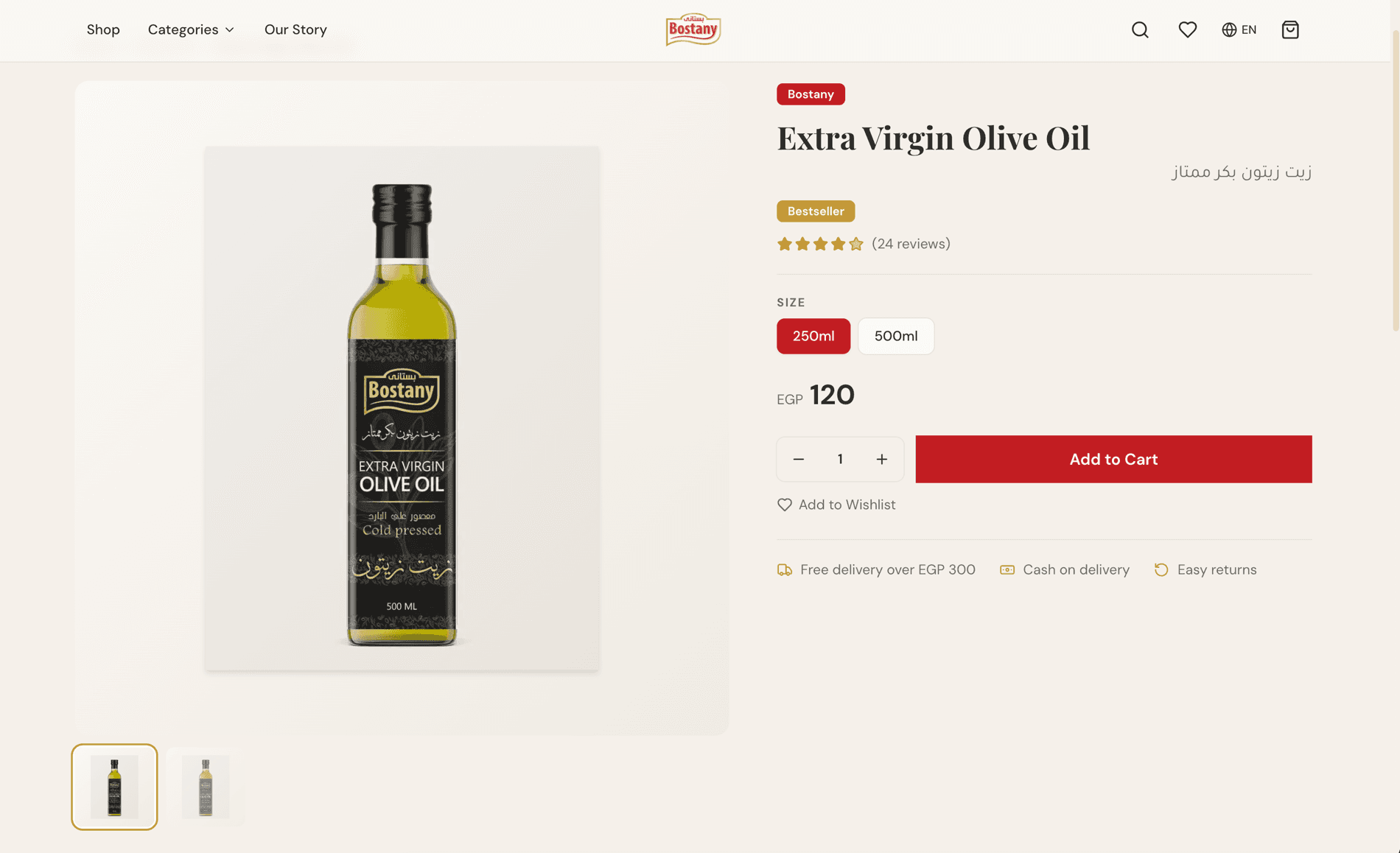
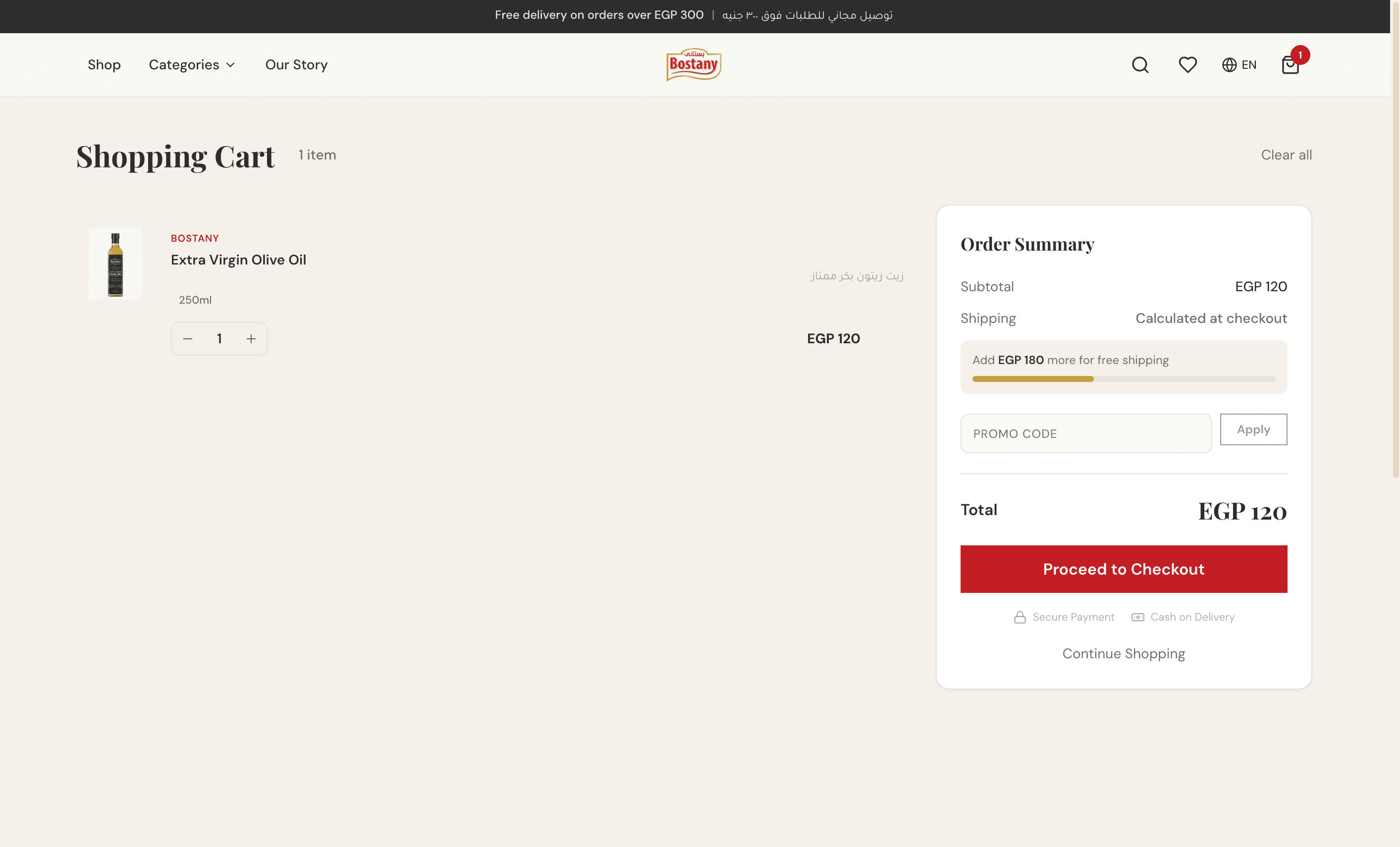
Around thirty SKUs across eight categories and seven sub-brands, each product carrying variants with their own size, price, SKU, stock and weight, because a 250ml and a 500ml bottle of the same olive oil are one product and two different things to buy. Around that sit the ordinary mechanics that decide whether a basket converts: filtering and search, a wishlist, promo codes, and the free-delivery threshold shown as distance remaining rather than buried in the footer.
Checkout the way Egypt actually pays
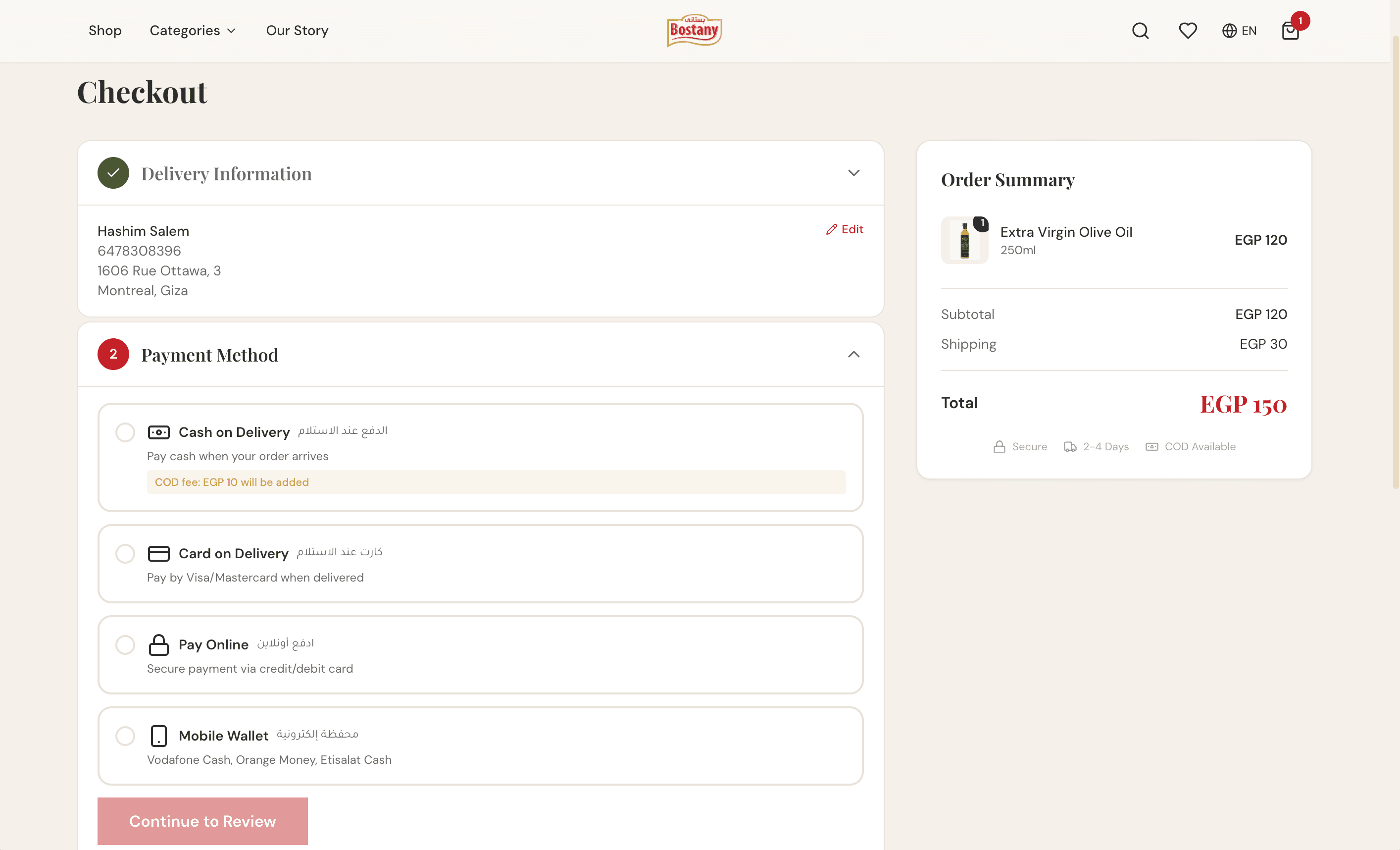
Most storefront templates assume a card. A large share of Egyptian first-time online buyers will not use one, so cash on delivery leads, with its EGP 10 fee stated on the option itself instead of discovered at the end. Card on delivery, online payment and mobile wallets follow. Guest checkout is a first-class path rather than an afterthought, phone plus OTP beats email as identity, shipping is modelled across all 27 governorates, and the address form asks for a landmark, because that is how a driver in Cairo actually finds a building.
Outcome
The result is a complete, clickable storefront in both languages: catalogue, filtering and search, product pages with variants, cart, a multi-step checkout, wishlist and a brand heritage page.
It stops at the frontend deliberately. Product data is static, there is no backend and no payment processing, so nothing here has taken an order. It exists to prove the design and the commerce model. The parts it stubs out, a payment gateway and courier integration on Egyptian rails, are the parts we have shipped for real on Sportify.
Want something like this?
Tell us what you're building and we'll give you an honest assessment of scope, timeline, and cost.